

本文主要解析PCIE在配置地址空间、LTP包转发、MSI中断描述三个方面中配置空间的struct。
具体来说就是,解析如下几个头文件中的源代码:
/include/linux/pci.h——核心PCI设备结构体
/include/linux/pci_regs.h——配置空间寄存器
/include/linux/pci-ep.h——PCI端点设备结构
PCIE协议对应源文件:Specifications | PCI-SIG(这里是官网下载,本文讲的是配置空间的事情,可以看这个文件:https://members.pcisig.com/wg/PCI-SIG/document/23941,或者这个盗版的:NCB-PCI_Express_Base_5.0r1.0-2019-05-22.pdf)
总线的struct在pci初始化部分单独讨论,这里重点讲的是pci_dev。
pci.h文件
从抽象层的逻辑实现角度来说,这个文件有如下3个主要功能要实现:
1、以struct pci_dev来实现PCIE设备的结构体描述,在这个struct中规定对应的设备标识、中断号、BAR资源数组
2、以struct resource来定义BAR空间在内核中的实现,包括BAR的起始物理地址、结束物理地址、资源名称、资源类型标志等信息(注意,resoruce来源于/include/linux/ioport.h文件)
3、配置空间访问API,config区域的读写方法(8位、16位、32位的共6种方法)
注意,这里起始是在枚举的时候,对PCIE寄存器地址空间进行解析的一个struct,所以需要遵循PCIE协议所描述的寄存器中对应的数据结构:
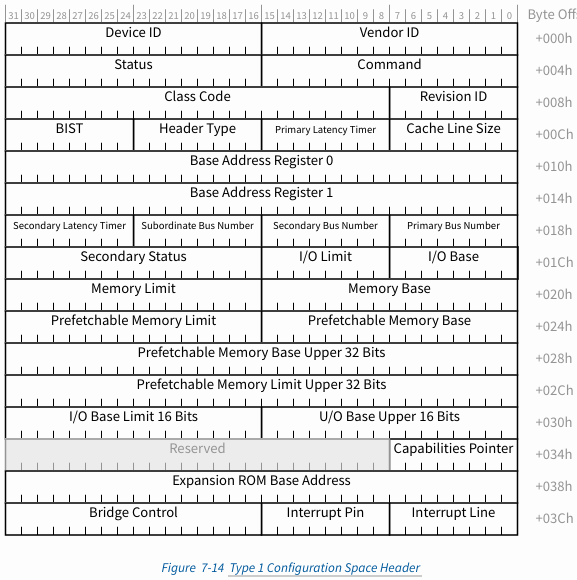
对于pci_dev设备来说,首先是在枚举的时候,会从BAR空间中按标准的结构解析配置参数出来,这里有关BAR空间这种标准通用配置空间的结构,是在pci_regs.h文件中进行描述与解析的,而对应的Base Address Register映射过去的空间中,各寄存器的含义,则需要由各PCIE设备的私有化驱动内部struct再进一步解析。
如下是pce_dev结构体的主要结构:(对于各种不同的设备结构,其由驱动初始化,产生对应实例化pci_dev的时候)
pci_dev结构:(这个struct更多的是kernel内部用的,跟BAR空间其实没有直接对应关系)
/* The pci_dev structure describes PCI devices */
struct pci_dev {
	struct list_head bus_list;	/* Node in per-bus list */
	struct pci_bus	*bus;		/* Bus this device is on */
	struct pci_bus	*subordinate;	/* Bus this device bridges to */

	void		*sysdata;	/* Hook for sys-specific extension */
	struct proc_dir_entry *procent;	/* Device entry in /proc/bus/pci */
	struct pci_slot	*slot;		/* Physical slot this device is in */

	unsigned int	devfn;		/* Encoded device & function index */
	unsigned short	vendor;
	unsigned short	device;
	unsigned short	subsystem_vendor;
	unsigned short	subsystem_device;
	unsigned int	class;		/* 3 bytes: (base,sub,prog-if) */
	u8		revision;	/* PCI revision, low byte of class word */
	u8		hdr_type;	/* PCI header type (`multi' flag masked out) */
#ifdef CONFIG_PCIEAER
	u16		aer_cap;	/* AER capability offset */
	struct aer_stats *aer_stats;	/* AER stats for this device */
#endif
#ifdef CONFIG_PCIEPORTBUS
	struct rcec_ea	*rcec_ea;	/* RCEC cached endpoint association */
#endif
	u32		devcap;		/* PCIe Device Capabilities */
	u8		pcie_cap;	/* PCIe capability offset */
	u8		msi_cap;	/* MSI capability offset */
	u8		msix_cap;	/* MSI-X capability offset */
	u8		pcie_mpss:3;	/* PCIe Max Payload Size Supported */
	u8		rom_base_reg;	/* Config register controlling ROM */
	u8		pin;		/* Interrupt pin this device uses */
	u16		pcie_flags_reg;	/* Cached PCIe Capabilities Register */
	unsigned long	*dma_alias_mask;/* Mask of enabled devfn aliases */

	struct pci_driver *driver;	/* Driver bound to this device */
	u64		dma_mask;	/* Mask of the bits of bus address this
					   device implements.  Normally this is
					   0xffffffff.  You only need to change
					   this if your device has broken DMA
					   or supports 64-bit transfers.  */

	struct device_dma_parameters dma_parms;

	pci_power_t	current_state;	/* Current operating state. In ACPI,
					   this is D0-D3, D0 being fully
					   functional, and D3 being off. */
	unsigned int	imm_ready:1;	/* Supports Immediate Readiness */
	u8		pm_cap;		/* PM capability offset */
	unsigned int	pme_support:5;	/* Bitmask of states from which PME#
					   can be generated */
	unsigned int	pme_poll:1;	/* Poll device's PME status bit */
	unsigned int	d1_support:1;	/* Low power state D1 is supported */
	unsigned int	d2_support:1;	/* Low power state D2 is supported */
	unsigned int	no_d1d2:1;	/* D1 and D2 are forbidden */
	unsigned int	no_d3cold:1;	/* D3cold is forbidden */
	unsigned int	bridge_d3:1;	/* Allow D3 for bridge */
	unsigned int	d3cold_allowed:1;	/* D3cold is allowed by user */
	unsigned int	mmio_always_on:1;	/* Disallow turning off io/mem
						   decoding during BAR sizing */
	unsigned int	wakeup_prepared:1;
	unsigned int	runtime_d3cold:1;	/* Whether go through runtime
						   D3cold, not set for devices
						   powered on/off by the
						   corresponding bridge */
	unsigned int	skip_bus_pm:1;	/* Internal: Skip bus-level PM */
	unsigned int	ignore_hotplug:1;	/* Ignore hotplug events */
	unsigned int	hotplug_user_indicators:1; /* SlotCtl indicators
						      controlled exclusively by
						      user sysfs */
	unsigned int	clear_retrain_link:1;	/* Need to clear Retrain Link
						   bit manually */
	unsigned int	d3hot_delay;	/* D3hot->D0 transition time in ms */
	unsigned int	d3cold_delay;	/* D3cold->D0 transition time in ms */

#ifdef CONFIG_PCIEASPM
	struct pcie_link_state	*link_state;	/* ASPM link state */
	unsigned int	ltr_path:1;	/* Latency Tolerance Reporting
					   supported from root to here */
	int		l1ss;		/* L1SS Capability pointer */
#endif
	unsigned int	eetlp_prefix_path:1;	/* End-to-End TLP Prefix */

	pci_channel_state_t error_state;	/* Current connectivity state */
	struct device	dev;			/* Generic device interface */

	int		cfg_size;		/* Size of config space */

	/*
	 * Instead of touching interrupt line and base address registers
	 * directly, use the values stored here. They might be different!
	 */
	unsigned int	irq;
	struct resource resource[DEVICE_COUNT_RESOURCE]; /* I/O and memory regions + expansion ROMs */

	bool		match_driver;		/* Skip attaching driver */

	unsigned int	transparent:1;		/* Subtractive decode bridge */
	unsigned int	io_window:1;		/* Bridge has I/O window */
	unsigned int	pref_window:1;		/* Bridge has pref mem window */
	unsigned int	pref_64_window:1;	/* Pref mem window is 64-bit */
	unsigned int	multifunction:1;	/* Multi-function device */

	unsigned int	is_busmaster:1;		/* Is busmaster */
	unsigned int	no_msi:1;		/* May not use MSI */
	unsigned int	no_64bit_msi:1;		/* May only use 32-bit MSIs */
	unsigned int	block_cfg_access:1;	/* Config space access blocked */
	unsigned int	broken_parity_status:1;	/* Generates false positive parity */
	unsigned int	irq_reroute_variant:2;	/* Needs IRQ rerouting variant */
	unsigned int	msi_enabled:1;
	unsigned int	msix_enabled:1;
	unsigned int	ari_enabled:1;		/* ARI forwarding */
	unsigned int	ats_enabled:1;		/* Address Translation Svc */
	unsigned int	pasid_enabled:1;	/* Process Address Space ID */
	unsigned int	pri_enabled:1;		/* Page Request Interface */
	unsigned int	is_managed:1;
	unsigned int	needs_freset:1;		/* Requires fundamental reset */
	unsigned int	state_saved:1;
	unsigned int	is_physfn:1;
	unsigned int	is_virtfn:1;
	unsigned int	reset_fn:1;
	unsigned int	is_hotplug_bridge:1;
	unsigned int	is_pciehp:1;
	unsigned int	shpc_managed:1;		/* SHPC owned by shpchp */
	unsigned int	is_thunderbolt:1;	/* Thunderbolt controller */
	/*
	 * Devices marked being untrusted are the ones that can potentially
	 * execute DMA attacks and similar. They are typically connected
	 * through external ports such as Thunderbolt but not limited to
	 * that. When an IOMMU is enabled they should be getting full
	 * mappings to make sure they cannot access arbitrary memory.
	 */
	unsigned int	untrusted:1;
	/*
	 * Info from the platform, e.g., ACPI or device tree, may mark a
	 * device as "external-facing".  An external-facing device is
	 * itself internal but devices downstream from it are external.
	 */
	unsigned int	external_facing:1;
	unsigned int	broken_intx_masking:1;	/* INTx masking can't be used */
	unsigned int	io_window_1k:1;		/* Intel bridge 1K I/O windows */
	unsigned int	irq_managed:1;
	unsigned int	non_compliant_bars:1;	/* Broken BARs; ignore them */
	unsigned int	is_probed:1;		/* Device probing in progress */
	unsigned int	link_active_reporting:1;/* Device capable of reporting link active */
	unsigned int	no_vf_scan:1;		/* Don't scan for VFs after IOV enablement */
	unsigned int	no_command_memory:1;	/* No PCI_COMMAND_MEMORY */
	unsigned int	rom_bar_overlap:1;	/* ROM BAR disable broken */
	pci_dev_flags_t dev_flags;
	atomic_t	enable_cnt;	/* pci_enable_device has been called */

	u32		saved_config_space[16]; /* Config space saved at suspend time */
	struct hlist_head saved_cap_space;
	struct bin_attribute *rom_attr;		/* Attribute descriptor for sysfs ROM entry */
	int		rom_attr_enabled;	/* Display of ROM attribute enabled? */
	struct bin_attribute *res_attr[DEVICE_COUNT_RESOURCE]; /* sysfs file for resources */
	struct bin_attribute *res_attr_wc[DEVICE_COUNT_RESOURCE]; /* sysfs file for WC mapping of resources */

#ifdef CONFIG_HOTPLUG_PCI_PCIE
	unsigned int	broken_cmd_compl:1;	/* No compl for some cmds */
#endif
#ifdef CONFIG_PCIE_PTM
	unsigned int	ptm_root:1;
	unsigned int	ptm_enabled:1;
	u8		ptm_granularity;
#endif
#ifdef CONFIG_PCI_MSI
	const struct attribute_group **msi_irq_groups;
#endif
	struct pci_vpd *vpd;
#ifdef CONFIG_PCIE_DPC
	u16		dpc_cap;
	unsigned int	dpc_rp_extensions:1;
	u8		dpc_rp_log_size;
#endif
#ifdef CONFIG_PCI_ATS
	union {
		struct pci_sriov	*sriov;		/* PF: SR-IOV info */
		struct pci_dev		*physfn;	/* VF: related PF */
	};
	u16		ats_cap;	/* ATS Capability offset */
	u8		ats_stu;	/* ATS Smallest Translation Unit */
#endif
#ifdef CONFIG_PCI_PRI
	u16		pri_cap;	/* PRI Capability offset */
	u32		pri_reqs_alloc; /* Number of PRI requests allocated */
	unsigned int	pasid_required:1; /* PRG Response PASID Required */
#endif
#ifdef CONFIG_PCI_PASID
	u16		pasid_cap;	/* PASID Capability offset */
	u16		pasid_features;
#endif
#ifdef CONFIG_PCI_P2PDMA
	struct pci_p2pdma *p2pdma;
#endif
	u16		acs_cap;	/* ACS Capability offset */
	phys_addr_t	rom;		/* Physical address if not from BAR */
	size_t		romlen;		/* Length if not from BAR */
	char		*driver_override; /* Driver name to force a match */

	unsigned long	priv_flags;	/* Private flags for the PCI driver */
};
resource结构:(本体源自/include/linux/opport.h,此处被实例化为具体的device)
struct resource {
	resource_size_t start;
	resource_size_t end;
	const char *name;
	unsigned long flags;
	unsigned long desc;
	struct resource *parent, *sibling, *child;
};
API接口函数:
int pci_read_config_byte(const struct pci_dev *dev, int where, u8 *val);
int pci_read_config_word(const struct pci_dev *dev, int where, u16 *val);
int pci_read_config_dword(const struct pci_dev *dev, int where, u32 *val);
int pci_write_config_byte(const struct pci_dev *dev, int where, u8 val);
int pci_write_config_word(const struct pci_dev *dev, int where, u16 val);
int pci_write_config_dword(const struct pci_dev *dev, int where, u32 val);

// 具体实现来自/drivers/pci/access.c文件:
int pci_read_config_byte(const struct pci_dev *dev, int where, u8 *val)
{
	if (pci_dev_is_disconnected(dev)) {
		*val = ~0;
		return PCIBIOS_DEVICE_NOT_FOUND;
	}
	return pci_bus_read_config_byte(dev->bus, dev->devfn, where, val);
}